
Tactical Clothing for Daily Wear: Style Guide
Table of Contents
- Why Tactical Clothing for Daily Wear Beats Standard Apparel
- What Makes Tactical Clothing Different From Standard Apparel?
- Key Features That Separate Tactical Apparel From Basics
- Low Profile Tactical Pants: Function Without the Uniform Look
- Everyday Carry Clothing: Discreet Storage That Works
- How to Build a Casual Tactical Outfit for Work and Weekend
- Best Tactical Brands for Daily Use: What to Look For
- Caring for Specialized Fabrics and Getting the Right Fit
- Frequently Asked Questions
Last Updated: September 11, 2026
Why Tactical Clothing for Daily Wear Beats Standard Apparel
Tactical clothing for daily wear is apparel engineered for movement, abrasion resistance, and utility, then cut to look like ordinary civilian clothes. That combination is why so many veterans, off-duty officers, and first responders reach for it on a Tuesday morning, not just on a range day.
At Green to Blue Tactical, we hear the same thing from customers: standard cotton basics wear out fast, restrict your shoulders when you reach, and leave you with nowhere to carry a phone, wallet, and multi-tool without a bag. Purpose-built apparel solves all three problems at once. The trade-off most people worry about, looking like they're in uniform, is largely a styling question, not a product one. Below, we break down what actually separates tactical apparel from basics, how to wear it without the costume effect, and what to check before you buy.
What Makes Tactical Clothing Different From Standard Apparel?
The difference comes down to three things: how the fabric is built, how the garment is cut, and how it carries your gear.
Durability and range of motion. Reinforced stitching at stress points, gusseted or articulated knees, and stretch-woven panels let you squat, climb, and reach without splitting a seam. Standard denim and cotton twill offer none of that. A common mistake is buying pants with a great fabric but a straight, non-articulated cut; the fabric survives, but the fit fights you every time you crouch.
Moisture management and breathability. Performance apparel moves sweat away from your skin and dries quickly, which matters whether you're on a foot pursuit or running errands in July. Base layers, mid-layers, and outerwear each play a different role here, and layering them correctly does more for comfort than any single piece.
Key Features That Separate Tactical Apparel From Basics
Look for ripstop fabric, DWR coating, and stretch-woven construction. Those three cover most of what you need for daily wear, but the details behind each one are what separate a garment that lasts three years from one that lasts ten.
Ripstop fabric. Ripstop gets its name from a grid of thicker reinforcement threads woven into a lighter base fabric. When a tear starts, it hits the grid and stops instead of running down the panel. The grid pattern is visible on close inspection, which is why some ripstop looks slightly technical up close. Common weights for daily-wear pants run from about 4.5 to 7 ounces per square yard; lighter weights breathe better, heavier weights resist abrasion longer (peer-reviewed research). A common mistake is assuming all ripstop is equal. A 4-ounce nylon ripstop and a 7-ounce cotton-blend ripstop behave very differently in the wash and on the trail.
DWR coating. Durable Water Repellent is a finish applied to the face fabric, not a membrane. It makes light rain and coffee spills bead up and roll off instead of soaking in. DWR is not waterproofing. It will not keep you dry in sustained rain, and it wears off with abrasion and repeated washing. When water stops beading and the fabric starts to look wet, the coating is spent and needs a spray-on or wash-in reapplication. Most practitioners find a fresh DWR treatment lasts through roughly 20 to 30 wash cycles before performance drops noticeably.
Stretch-woven panels. These are the panels that give a pant its range of motion without sacrificing abrasion resistance. Stretch-woven fabric is typically a blend of nylon or polyester with a small percentage of elastane, woven rather than knit so it still resists snags. The stretch usually shows up at the knees, the seat, and the crotch gusset, which are the three places a non-stretch pant fails first. If a pant claims stretch but has no gusset, the stretch is doing less work than the marketing suggests.
Reinforced stitching. Double stitching, bar tacks, and box-X patterns at pocket corners, belt loops, and knee seams are what keep a garment from coming apart at the stress points. This is one of the cheapest upgrades a manufacturer can make and one of the easiest to spot on a spec sheet or in person.
Utility pockets. Cargo storage sized for a phone, knife, or flashlight is the feature most people associate with tactical apparel, but pocket layout matters more than pocket count. A well-designed pant has a flat, zippered thigh pocket that does not bulge when empty, a reinforced front pocket mouth that does not stretch out, and a hidden waistband pocket for a spare magazine, card, or key. A poorly designed pant has four external flaps that announce themselves from across the room.
Moisture-wicking linings and quick-drying face fabrics round out the list. What most guides miss is that you rarely need all of these in one garment, and stacking every feature into a single piece is how you end up with something that looks like a uniform. For office wear, prioritize DWR and a clean silhouette. For outdoor work, prioritize ripstop and breathability. For travel, prioritize stretch and discreet storage. Match the feature set to the setting, not to the spec sheet.
Low Profile Tactical Pants: Function Without the Uniform Look
Low profile tactical pants are the single best entry point into this category, because they read as regular chinos or jeans while still carrying everything.
The giveaways that make pants look like a uniform are external cargo flaps, loud contrast stitching, and a baggy tactical cut. Discreet versions move the storage inside: hidden waistband pockets, zippered thigh pockets that lie flat, and a slimmer leg. Look for a tactical belt that sits flush, and choose colors that match what's already in your closet, like charcoal, khaki, or dark olive.
Everyday Carry Clothing: Discreet Storage That Works
Everyday carry clothing is apparel designed to distribute weight across the body so your EDC gear stays accessible and invisible.
Good EDC integration means a reinforced belt that supports a holster or tool without sagging, pockets with reinforced mouths that don't stretch out, and pocket placement that doesn't print. If you carry concealed, a stiff tactical belt and a slightly longer untucked shirt do more than any specialty pocket. For modular gear, look for loop-lined panels or internal attachment points that stay hidden when empty.
NIJ guidance on body armor and equipment fit
How to Build a Casual Tactical Outfit for Work and Weekend
Start with one tactical piece and keep everything else plain. That single rule solves 90% of the "too tactical" problem, but the remaining 10% is where most people still get it wrong. The gap competitors miss is office-appropriate styling: how to wear tactical apparel in a business-casual environment without looking like you wandered in from a range day.
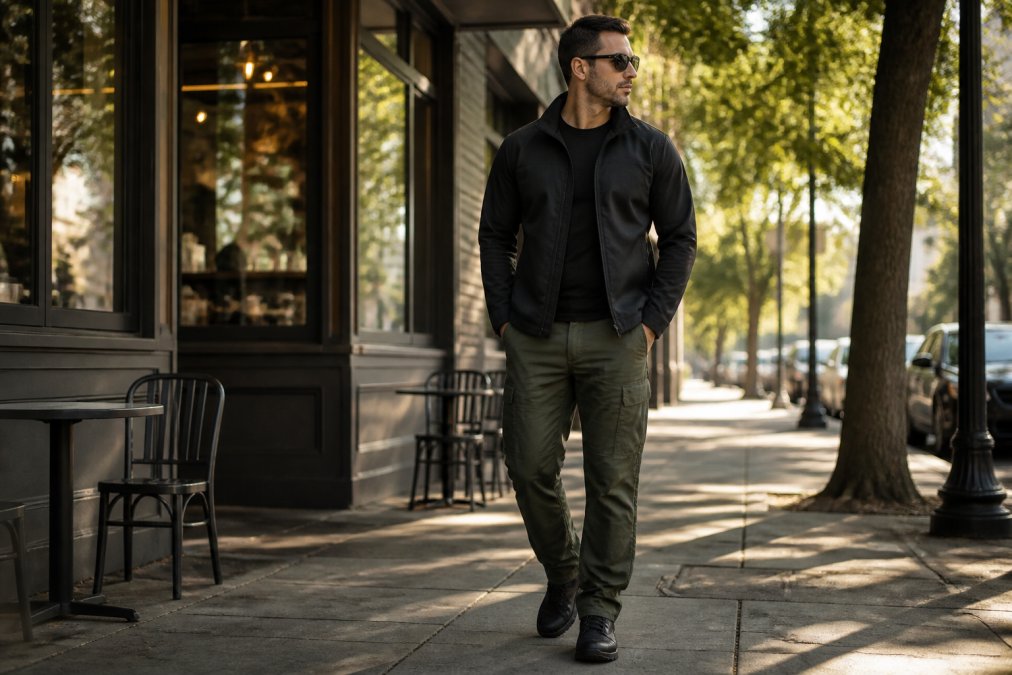
A workable formula:
- Low profile tactical pants in charcoal or khaki
- A plain merino or cotton base layer, no logos
- A neutral mid-layer or softshell in black, gray, or navy
- Clean sneakers or low-profile boots
The office rule. In a business-casual setting, the pants are the only tactical element. Swap the softshell for a plain blazer or quarter-zip, keep the shirt tucked or cleanly untucked depending on the dress code, and choose a pant color that matches the trousers your coworkers already wear. Charcoal, khaki, and dark olive read as chinos. Black reads as tactical. Camo, coyote brown, and ranger green read as field gear and should stay out of the office entirely. The goal is that a coworker notices your pants fit well, not that they notice your pants are tactical.
The weekend rule. On weekends you can add a second tactical element, usually a softshell or a hoodie, but not a third. A pant plus a softshell plus a cap is fine. A pant plus a softshell plus a cap plus a tactical belt plus a knife clip showing is a costume. Pick two and stop.
The travel rule. Travel is where tactical apparel earns its keep. A low-profile pant with a zippered thigh pocket and an EDC belt lets you carry a passport, phone, and wallet without a bag, and the DWR coating handles a sudden rain shower between the terminal and the rental car. Keep the rest of the outfit plain so you do not draw attention at a security checkpoint or in a foreign city.
The fit rule. The single biggest tell is fit. A baggy tactical pant reads as uniform no matter how neutral the color. Buy your actual waist and inseam, let the stretch-woven fabric handle movement, and if you are between sizes, size for the thigh and have the waist taken in. A tailor can take in a waist for a modest fee; they cannot fix a pant that is too tight in the seat.
| Setting | Tactical Element | Keep Everything Else | Why It Works |
|---|---|---|---|
| Office | Low profile pants | Plain shirt, blazer | Reads as business casual |
| Weekend | Pants + softshell | Hoodie, cap | Functional, not uniform |
| Travel | Pants + EDC belt | Plain tee, sneakers | Storage without a bag |
| Outdoor | Full layering system | Base, mid, outer | Weather resistance |
Best Tactical Brands for Daily Use: What to Look For
The best tactical brands for daily use share four traits: field-tested construction, honest fabric specs, consistent sizing, and a clear point of view about who they serve.
Skip any brand that won't tell you the fabric weight, the pocket layout, or the care instructions. Military-grade claims mean nothing without a spec sheet behind them. Look for brands that publish their sizing charts by body type, because fit guides for diverse body types are still rare in this category, and a pant that fits one build well can be unwearable on another.
This is where Green to Blue Tactical sits. Founded by a U.S. Army combat veteran and career law enforcement officer, the brand builds apparel around one message: your story isn't over. The clothing is designed for veterans, law enforcement, first responders, and their families, so it holds up to real use and still looks right at a school pickup or a dinner out. If you've worn a uniform and want apparel that respects that without shouting it, this is the audience the brand was built for.
Caring for Specialized Fabrics and Getting the Right Fit
Wash ripstop and stretch-woven garments in cold water and skip the fabric softener. Softener coats the fibers and kills both the DWR coating and the moisture-wicking finish.
- Reapply DWR spray when water stops beading
- Air dry when you can; low heat when you can't
- Turn garments inside out to protect zippers and stitching
- Avoid bleach and high heat, which break down stretch fibers
On fit: measure your actual waist and inseam, then check the brand's chart against your thigh and seat measurements, not just your waist. If you're between sizes, size for the thigh and have the waist taken in. Sustainable and eco-friendly tactical materials, including recycled ripstop and bluesign-approved fabrics, are increasingly common and perform just as well, so it's worth checking labels if that matters to you.
FTC guidance on textile labeling and care claims
Most people who try tactical clothing for daily wear quit because they bought one loud piece and wore it with everything else loud too. The fix is restraint: one functional garment, plain everything else, and a fit that matches your actual body. Green to Blue Tactical builds apparel for exactly that use case, with low profile tactical pants, everyday carry clothing, and layering pieces designed for veterans, officers, and first responders who want gear that works without announcing itself. Subscribe to our emails to see new drops and sizing guidance first.
Frequently Asked Questions
Can civilians legally own tactical clothing and gear?
Yes. Tactical clothing, including pants, jackets, and bags, is legal for civilians to buy and wear in all 50 states. Restrictions apply to specific items like body armor in some states and certain firearms accessories, but apparel itself carries no ownership limits. Everyday carry items such as knives or multi-tools may have local blade-length rules, so check your state and city ordinances before carrying. The clothing side is straightforward: if it fits and you like it, you can wear it.
How do you choose tactical clothing that doesn't look like a uniform?
Stick to solid, muted colors like gray, navy, khaki, or olive instead of camo or black-on-black. Skip external MOLLE webbing, large logo patches, and anything with visible Velcro panels. Choose low-profile tactical pants with hidden or slash pockets rather than bulky cargo flaps. Pair one tactical piece with civilian staples: a plain t-shirt, a casual button-down, or a denim jacket. The goal is functional fabric and smart storage in a silhouette that reads as normal streetwear, not duty gear.
What features should you look for in everyday tactical apparel?
Prioritize four things: fabric, fit, storage, and finish. Look for ripstop or stretch-woven materials with a DWR coating for weather resistance. Check for articulated knees and gusseted crotches, which improve range of motion. Utility pockets should be low-profile, not bulging. Reinforced stitching at stress points extends lifespan. Breathability matters too, so avoid fully waterproof shells for daily wear unless you need them. A good tactical belt with a low-profile buckle ties the fit together without announcing itself.
Is tactical gear appropriate for casual settings like restaurants or offices?
It can be, if you choose the right pieces. For offices, lean toward tactical chinos or stretch-woven pants in neutral colors paired with a polo or button-down. Leave the range bag and camo at home. For casual settings like restaurants or stores, low-profile tactical pants and a plain tactical jacket fit right in. The rule is simple: if the item looks like it belongs on a range or a duty belt, save it for those settings. If it looks like well-made everyday clothing, wear it anywhere.